Motorcycle Won’t Start: Battery or Hidden Fault
Hello, it’s Patrick.
If the starter struggles or stays silent, suspect the battery first; if it turns normally without starting the engine, look instead at the ignition or fuel system.
This distinction helps you avoid replacing parts at random. A few simple checks can already help identify a discharged motorcycle battery, a faulty relay, or a hidden problem.
What to check first
- Check the controls: neutral, kill switch, side stand, and clutch lever.
- Check the lights and indicators: dim lights may indicate a low battery.
- Listen to the motorcycle starter: note whether you hear a click, slow cranking, or nothing at all.
- Check the fuel: check the level and, on a fuel-injected motorcycle, listen for the pump priming when you turn the ignition on.
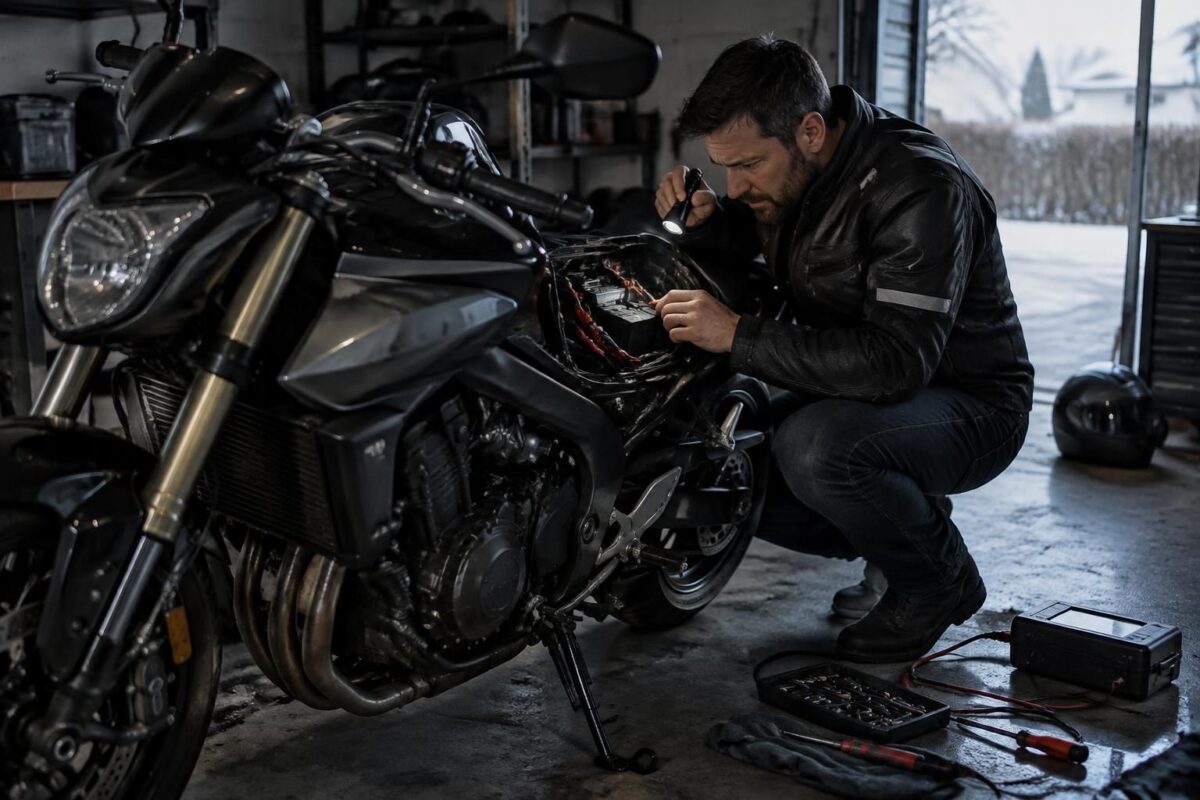
- Measure the voltage with a multimeter if you have one, without repeatedly pressing the starter button.
To compare symptoms and avoid unnecessary disassembly, consult this guide to telling a faulty battery from a failed stator and these tips on starter repair based on the noise you hear.
Motorcycle won’t start: the sound helps guide the diagnosis
When faced with a motorcycle that won’t start, the first question is simple: does the starter turn? An engine that cranks strongly points to the ignition or fuel supply; a click or silence points more toward the electrical system.
For example, if the indicator lights dim as soon as you press the button, the battery may not have enough power even if the dashboard lights up. So, an illuminated indicator does not guarantee that the battery can crank the engine.
| Symptom | Possible cause | First check |
|---|---|---|
| Single click, no cranking | Weak battery or starter relay | Measure the voltage, then inspect the connections |
| Slow, uneven cranking | Discharged or worn-out battery | Recharge and check the voltage while starting |
| The starter turns, but the engine won’t start | Ignition or fuel supply | Check the fuel and the condition of the spark plug |
| No response when pressing the button | Fuse, safety switch, or starter circuit | Check the kill switch, side stand, clutch, and fuses |
Battery or stator: measurements that make the difference
A battery in good condition generally reads around 12.6 to 12.8 V at rest after a period without charging. Below 12 V, it is heavily discharged or possibly worn out; however, a single reading is not enough to confirm that it has failed.
Also check the voltage while operating the starter. If it drops below about 9.5 V, the battery may no longer be able to supply enough current. If the voltage remains normal but the starter does not respond, check the relay, cables, fuses, or the starter itself instead.
Once the engine is running, the voltage across the battery terminals should generally rise to around 13.5 to 14.5 V. If it does not increase, the charging system needs to be checked: stator, regulator, and connections. The stator is sometimes called a motorcycle alternator, although the design varies between models.
Three steps to isolate the problem
- Rule out the simple causes: check the safety switches, kill switch, neutral, fuel level, and battery terminals. A loose or corroded connection can be enough to cause an electrical problem on a motorcycle.
- Check the battery and starting system: take a voltage reading at rest and while starting. A single click with a properly charged battery may point to the relay; slow cranking is more likely to indicate an inadequate power supply.
- If the engine turns over but won’t start, check the ignition and fuel: inspect the spark plug and make sure fuel is reaching the engine. To test for a spark, follow the procedure in the manual and keep all fuel and flammable vapors away; if in doubt, have a professional carry out the check.
Avoid hitting the starter or making repeated attempts: these actions can make the problem worse or hide the actual fault. A suitable booster can help with a weak battery, but it won’t fix a faulty relay or a problem with the charging circuit.
If the starter turns, check the ignition
When the engine is cranking at normal speed, the battery is less likely to be the reason it won’t start. Check the spark plug, spark plug cap, and fuel supply instead; on a fuel-injected motorcycle, listen for the brief priming sound from the pump when you turn the ignition on.
Electronic safety systems can also prevent the engine from starting, even if the starter turns: the side stand, clutch switch, or tip-over sensor. A motorcycle that has been sitting for a long time may also have a fouled spark plug or degraded fuel.
For an accurate motorcycle diagnosis, note the symptoms before taking anything apart: the sound you hear, how the indicator lights behave, and the voltage readings. These clues reduce the risk of replacing a working part when the real problem is hidden.
How can you tell if a motorcycle battery is discharged?
The indicator lights or headlights may dim, and the starter may turn slowly or click. Measure the voltage at rest, then while starting; a significant drop means the battery and connections should be checked.
The starter turns, but the motorcycle won’t start: what should you check?
Check the fuel level, fuel supply, spark plug, and safety switches such as the side stand or clutch switch. If the engine is cranking normally, the problem is often not the battery.
Can a charged battery hide a stator problem?
Yes. If the voltage does not rise while the engine is running, the charging system may be at fault. The stator, regulator, or their connections should then be checked.
When should you stop trying and consult a mechanic?
Stop if the cables get hot, you notice a burning smell, the battery is swollen, or diagnosis requires testing the ignition circuit near fuel. A professional can check the circuit safely.
Thanks for reading! Feel free to share your observations in the comments. — Patrick