
Car without a workshop: how to choose the right tools
Hi, it’s Patrick. To maintain your car without a workshop, start with a reliable basic kit: sockets, a hydraulic jack, jack stands, a torque wrench and inspection tools. Choose each piece according to the planned interventions and the manufacturer’s instructions. In my article, I help you build a practical setup, without buying the entire mechanics aisle all at once.
To do immediately:
- Consult the manual for your car to locate the lifting points and the torque specifications.
- Check the size of the front wheel nuts before buying a wrench or a socket set.
- Plan jack stands suited to the vehicle’s weight to work safely.
- Keep a pressure gauge, a flashlight and gloves in your car tools kit.
- Start with a simple operation, such as checking tire pressure or replacing an accessible filter.
To broaden your list without getting distracted, compare these tips on the tools useful for getting started in mechanics and on the value of a torque wrench.
Choosing your automotive tools according to the planned work
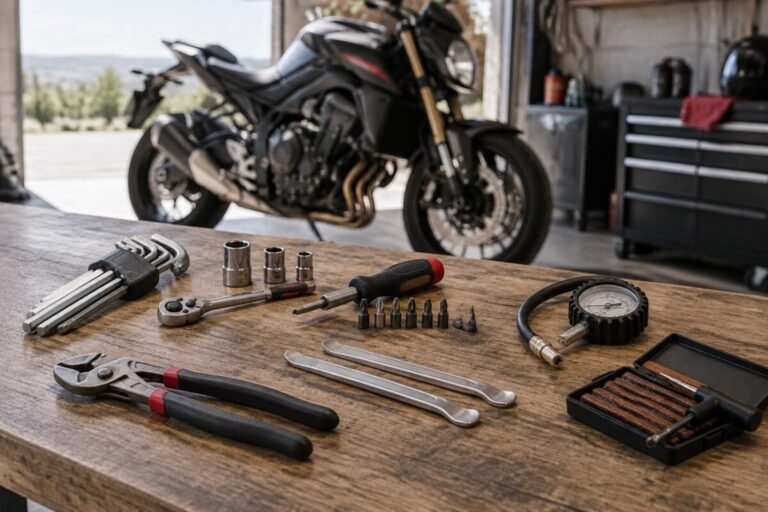
For an oil change, a wheel change or the replacement of a filter, a few well-chosen tools are often enough. The mechanical tooling must match your car and your level: a socket set, screwdrivers, pliers and reliable lighting form a solid base.
A kit covering the common sizes, around 8 to 19 mm depending on the vehicles, allows you to perform several simple operations. Six-point sockets and a ratchet with an extension facilitate gripping the nuts and accessing tight areas. Choose a quality suited to the frequency of use, rather than a large kit filled with tools that will never be used.
Quick cases: If you mainly do routine maintenance, favor sockets, the drain pan and the oil filter wrench. If you want to work on the wheels or under the car, equip yourself first for lifting and safety.
A basic setup for maintenance without a workshop
For an oil change, add a catch basin of about 8 liters or more, a funnel, rags and nitrile gloves. Check the type of filter before buying a wrench: some come off with a strap, others require a specific socket.
A tire pressure gauge and a headlamp are also useful outside of the garage. They let you check the tires when cold and see clearly in the engine bay, without occupying both hands.
| Tool | Main use | Selection tip |
|---|---|---|
| Socket set and ratchet | Remove or tighten fasteners | Choose common sizes and an extension |
| Drain pan and funnel | Collect and pour fluids | Choose a pan shallow enough to pass under the car |
| Pressure gauge | Check tires | Compare the reading to the manufacturer’s values |
| Multimeter | Check a battery or a circuit | A simple model with voltmeter and ohmmeter is often enough |
| OBD-II scanner | Read certain electronic faults | Check its compatibility with the vehicle |
Lifting and automotive safety: the priorities before repairing
The jack is used to lift the car, not to support it while you work underneath. Always place jack stands on a flat surface and at the points indicated by the manufacturer. A hydraulic jack of at least two tons is often suitable for light cars, but check the capacity and the height required for your model.
Automotive safety also involves simple steps: set the hand brake, engage a gear or the Park (P) mode, then chock the wheels that remain on the ground. Never crawl under a vehicle supported only by a jack. If the ground is inclined or unstable, postpone the intervention.
Sam, who wanted to replace a wheel in his driveway, had prepared his jack but not his chocks. He took a few minutes to secure the car before continuing: this little detour is better than a rushed repair.
Step 1/2/3: preparing a simple intervention
- Step 1: Check the manual, gather the tools and check their condition. Make sure the part and the dimensions match your car.
- Step 2: Park on a flat surface, immobilize the vehicle and install the necessary protective equipment. To lift the car, place the jack stands at the designated points.
- Step 3: Perform the operation without forcing and respect the values indicated by the manufacturer. After the work, check the assembly and store the tools clean and dry.
Torque wrench and automotive diagnostics: buy at the right time
A torque wrench allows applying the prescribed tightening torque, notably on the wheels or certain engine components. For a versatile use, a range around 20 to 150 Nm suits many jobs, depending on the vehicle. After use, set it to its minimum value in accordance with the manufacturer’s instructions.
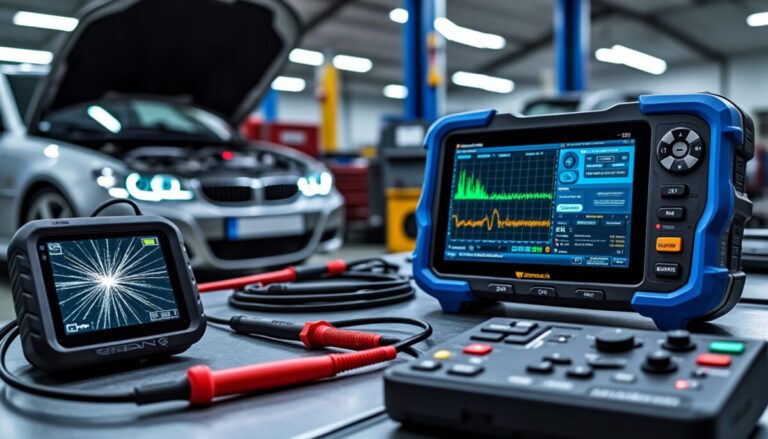
For the automotive diagnostics, a multimeter helps to check the battery voltage and the continuity of a circuit. An OBD-II reader can display fault codes on many newer cars, but a code does not always directly indicate the part to replace: it serves as a lead, not a verdict.
“The right tool often prevents turning a small maintenance into a big problem.” This is especially true for tightening: an approximate force can damage a thread or leave a fastener insufficiently tightened.
Building a car tool kit without spending too much
To choose your tools, first look at how often you will use them. If you do two or three simple interventions per year, a mid-range setup can usually be enough. For regular use or multiple vehicles, favor more robust tools and a clear warranty.
- At home: sockets, screwdrivers, pliers, drain pan, oil filter wrench and torque wrench.
- In the car: pressure gauge, a compatible wheel wrench, a lamp, gloves and a portable jump starter if you know how to use it.
- For organization: store tools by category in a closed chest, away from moisture and shocks.
A portable jump starter can help in case of a weak battery, provided you follow its manual exactly and check its compatibility with the vehicle. Duct tape and zip ties can help temporarily hold a non-essential part, but they do not replace proper repair.
Practical questions for repairing your car at home
What tools to buy first to maintain your car?
Start with a socket set with a ratchet, a pressure gauge, screwdrivers, pliers and a lamp. Add the equipment needed for the operation you plan next.
Can you work under a car with just a jack?
No. The jack is for lifting. Always support the vehicle with suitable jack stands, placed on a flat surface and at the designated lifting points.
Is a torque wrench necessary to get started?
It becomes important as soon as a tightening must meet a precise value, especially for the wheels. Check the torque values prescribed by the manufacturer and the manual for the wrench.
Is an OBD-II reader sufficient to repair a fault?
It can read some fault codes and guide the diagnosis. It does not always confirm the exact cause: complete the analysis with the symptoms and the vehicle’s documentation.
Thanks for reading; best regards Patrick