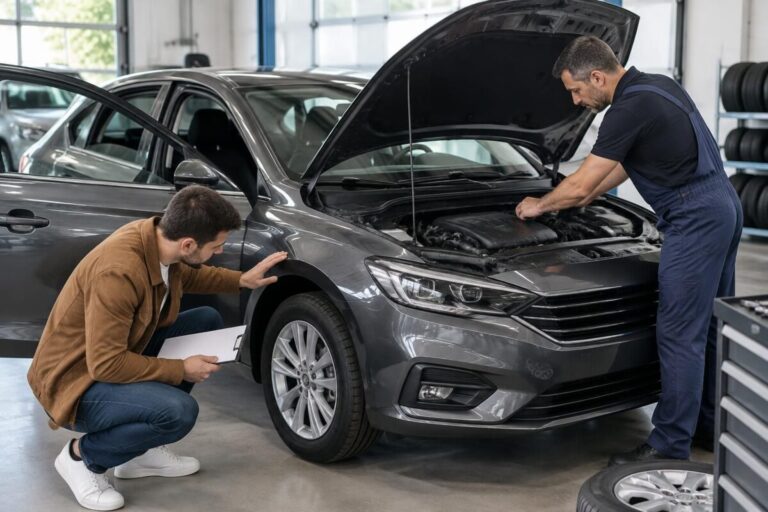

First car for a young driver: which one avoids unpleasant surprises?
Hi, I’m Patrick. To avoid any nasty surprises, look for a used, low-powered petrol city car that’s well maintained and affordable to insure. The right choice doesn’t depend on the asking price alone: you also need to factor in insurance, fuel consumption and potential repairs. A few checks before you buy can make a real difference.
Things to do right away
- Set an overall budget that includes the purchase, insurance, fuel and maintenance.
- Get an insurance quote using the registration number before paying a deposit.
- Check the power: under 6 fiscal horsepower and around 90 to 100 DIN horsepower are useful benchmarks.
- Ask for proof: invoices, a service log and a recent roadworthiness test.
- Test-drive the car from cold and check the safety features, such as ABS, airbags and ESP.
A car for a young driver should be easy to drive and maintain. To compare the criteria before viewing cars, also check out our guide to the criteria that help you avoid a bad first purchase and our tips for choosing a first used or nearly new car.
Which models should you avoid as a first car?
The classic trap is buying a car that’s fun to drive without checking its true cost. Sports versions, powerful SUVs and premium models can come with high premiums, costly repairs and difficulty manoeuvring.
A Clio RS, 208 GTI, Golf GTI or Mini Cooper S isn’t necessarily illegal to drive. However, some insurers may refuse to cover a novice or charge them a high premium. A high-value recent car may also require comprehensive cover, while a very old model may lack safety features or need unexpected repairs.
| Vehicle type | Common risk | More sensible alternative |
|---|---|---|
| Sports car or GTI/RS trim | Expensive insurance, high power | Petrol city car with moderate power |
| Large SUV or 4×4 | Higher price, larger size and fuel consumption | Small versatile car that’s easy to park |
| Premium model | Costly parts and maintenance | Widely available vehicle with readily available parts |
| Very old car | Safety and reliability may be limited | Used car with a verifiable service history |
The cost of insurance for a young driver depends on their profile, location and vehicle. A young-driver surcharge can amount to several hundred euros a year, sometimes more, so get several quotes rather than relying on a general estimate.
What makes a car reliable and economical?
For a first purchase, a common petrol city car often offers a good compromise. A Renault Clio, Toyota Yaris, Dacia Sandero or Peugeot 208 could be a good fit, depending on the engine, year and condition of the specific car. The model name alone isn’t enough: a poorly maintained car can cost more than another, even one with a reputation for reliability.
Prioritise low fuel consumption, readily available parts and maintenance costs that fit your car budget. Petrol engines are often suitable for short urban trips. Diesel makes more sense if you regularly cover long distances; an electric car may be a good option if the purchase price and charging suit your needs.
- Compare the purchase price with the cost of insurance and routine repairs.
- Check for ABS, airbags and ESP, especially on an older car.
- Rule out listings with surprisingly low prices until you’ve clarified the vehicle’s history.
- Have a professional inspect the car if you can’t assess its mechanical condition yourself.
Repair costs for automated manual gearboxes and certain engines can vary significantly depending on the generation and maintenance history. Don’t rule out a model based on its name alone: check the exact engine, gearbox and invoices for the specific car you’re considering.
Three steps to avoid nasty surprises
- Work out the true cost. Get insurance quotes and estimate fuel, maintenance and potential repairs before setting a maximum price.
- Check the history. Compare the mileage with the invoices, review the roadworthiness test and ask whether the vehicle has been in an accident or had major repairs.
- Test-drive it and get it inspected. Test the brakes, clutch, steering and features, then ask a mechanic to check it before signing if you have any doubts.
Here’s a real-life example: Lina is choosing between an inexpensive sporty hatchback and a city car with better documentation. The insurance quote and a review of the invoices show that the latter is a better fit for her journeys and budget. It’s often this kind of check, rather than the asking price, that helps you avoid nasty surprises.
Is a used car always the best choice?
Not necessarily, but it often means a lower initial outlay and less depreciation. A recent, well-maintained used car can offer a good balance of safety, features and cost, as long as you check its history and don’t overlook insurance.
Which engine should you choose if you mostly drive in the city?
A low-powered petrol engine is generally suitable for short, frequent journeys. For regular long-distance trips, compare diesel options too, taking local restrictions and maintenance costs into account.
Your first car doesn’t need to be spectacular to be a success. A model that suits your journeys, is properly insured and has been carefully maintained will mainly give you the confidence you need to improve your driving at your own pace.
Thanks for reading! Feel free to share your thoughts in the comments. — Patrick