
Regular maintenance: why your motorcycle returns it to you
Hello, this is Patrick. Do you want your motorcycle to stay performing and safe? Regular maintenance is the key. Without spending a fortune, a regular maintenance will keep your motorcycle responsive, reliable and above all enjoyable to ride on a daily basis. Engine longevity and your road safety depend largely on this simple routine to adopt.
Do immediately:
- Check the pressure and condition of the tires before every ride.
- Check the engine oil levels, brake fluid, and coolant.
- Quickly inspect the lights and lighting to ensure good visibility.
- Lubricate and adjust the chain to prevent premature wear.
- Test braking, pads and levers to ensure an effective response.
What follows will give you practical solutions to never neglect your periodic maintenance and avoid costly breakdowns. To go further, I invite you to consult the comprehensive guide for maintaining your motorcycle and discover how to maintain your motorcycle: revisions and oil changes.
Why regular maintenance optimizes motorcycle performance and prevents breakdowns
An engine suffers if left neglected. Friction and buildup set in, power drops, and consumption rises. By regularly maintaining oils, filters, and the lubrication of the transmission, you keep smooth operation. This is a virtuous circle that reduces the risk of breakdown and extends the life of mechanical parts.
If you ride a sporty motorcycle, extra attention to the transmission and braking system is essential. For more casual use, checks can be monthly but still precise. Without good maintenance, even the best machine quickly reveals its weaknesses.
Key steps for effective periodic maintenance
- Complete level checks: engine oil, brake fluid, coolant, checked cold and adjusted if necessary.
- Detailed inspection of the chain and wear components: lubrication, tension, and checking the condition of the brake pads.
- Active safety analysis: lighting, tires, brakes, to ensure a healthy and safe ride.
A simple anecdote: a friend realized too late that a quick check of his tires was due. An invisible nail caught him off guard mid-ride, forcing an emergency stop, hassle, and avoidable costs.
Essential tools to ensure successful regular home maintenance
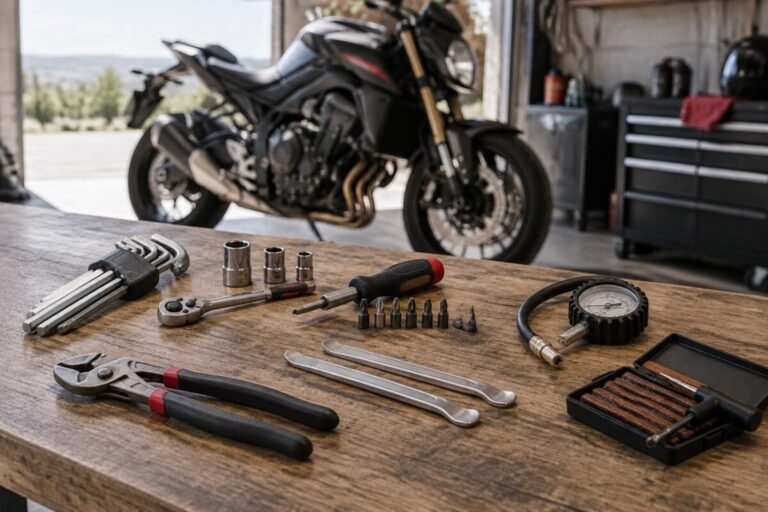
Let’s be honest, no maintenance is successful without proper equipment. A basic kit including Allen keys, flat-head and Phillips screwdrivers, socket wrenches, and an adjustable wrench is a must. Additionally, an oil drain pan, a dedicated filter wrench, and a workshop jack will simplify your interventions.
A nice bonus can come from organization: protective gloves, microfiber cloths and dedicated cleaning products will make all the difference in preventing scratches or injuries. By investing in good equipment, you save time, increase safety, and you preserve the mechanical reliability of your motorcycle.
Pro tips to always keep in mind
- Never neglect chain tension and lubrication – it is vital.
- Scan components for a motorcycle diagnostic as soon as the warning light appears.
- Replace oil and air filters before they saturate, ideally between 15,000 and 30,000 km.
- Regularly clean the engine compartment to prevent overheating and wear on contacts.
- Schedule a periodic maintenance beyond a simple oil change to adjust valve lash and check the steering column.
Frequency and calendar of motorcycle maintenance: keeping a suitable rhythm
Maintenance should not be done randomly. The manufacturers’ prudent guidelines call for typical intervals between 6,000 and 12,000 km, or once a year. The motorcycle will then undergo an oil change, brake check, chain tension, and tire verification. The situation varies with usage and model, but regularity remains the safest method.
If the motorcycle is stored for winter without riding, it’s the perfect opportunity for a full check of the battery, hoses, and brake fluid which loses effectiveness over time. Annual maintenance should leave nothing to chance.
| Operation | Break-in at 1,000 km | 5-6,000 km | 10-12,000 km | Annual |
|---|---|---|---|---|
| Oil change + oil filter | ✓ | According to usage | ✓ | If > 12 months |
| Air filter | — | Check / Replace | ✓ | — |
| Sparks | — | Check | ✓ | — |
| Chain (tension + lubrication) | ✓ | ✓ | ✓ | ✓ |
| Brake pads | — | Check | ✓ | ✓ |
| Brake fluid | — | Check | Check (every 2 years) | ✓ |
| Battery | — | — | Check | ✓ |
These milestones help you anticipate problems and keep your motorcycle in optimal condition. When you hear a noise or notice an anomaly, don’t hesitate: it’s better to intervene than to regret.
Safety and best practices for effective maintenance
“Safety is the first of performance,” said an old rider. Now more than ever this advice rings true. You should always protect yourself with gloves and safety glasses and work in a well-lit space. Disconnect the battery during electrical or mechanical interventions to prevent accidents. Using appropriate tools reduces errors and ensures a perfect assembly.
Work neatly: don’t leave tools or chemicals lying around. A tidy setup reduces fatigue and the risk of accidents; a clear mind is essential.
You will save time and money on repairs caused by negligence.
Final tips to keep control of your motorcycle all year round
Never underestimate the importance of maintenance, even when you’re in a hurry. A simple check sometimes takes just a few minutes, but can save you. Stay attentive to your motorcycle’s signals and don’t ignore the message by waiting too long.
Adopting a routine suited to your motorcycle over kilometers, consulting the manufacturer’s manual, and not hesitating to seek advice from a professional will improve your confidence and the lifespan of your machine.
I also recommend exploring comprehensive resources like the practical guide for maintaining your motorcycle which details in depth each step to follow.
Why is regular maintenance essential for my motorcycle?
Regular maintenance prevents premature wear, improves motorcycle performance, and reduces the risk of breakdowns, thus ensuring optimal road safety.
How often should I check my tires and chain?
Before each ride, a quick check of tire pressure and chain tension is recommended. A thorough inspection will be carried out during periodic maintenance.
What are the signs indicating that an immediate service is necessary?
Unusual noises, vibrations, starting difficulties, ineffective braking or leaks should alert and justify a quick intervention.
Can I do the maintenance of my motorcycle myself?
Some simple operations like checking fluid levels and chain lubrication are accessible, but complex checks often require a professional.
What is the difference between periodic maintenance and daily maintenance?
Daily maintenance includes quick checks before riding, while periodic maintenance is more complete, performed according to a precise schedule to prevent breakdowns.
Thank you for reading; best regards, Patrick