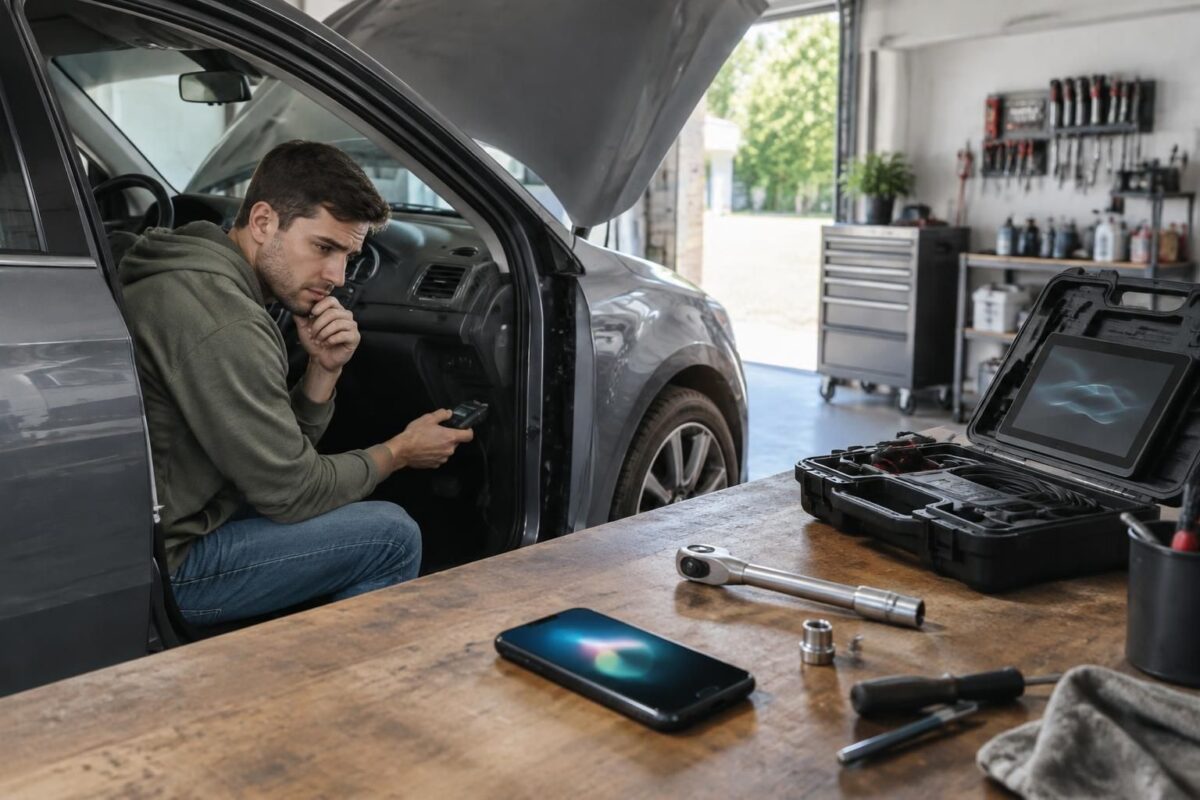
Car Diagnostic Tools: Useful or Misleading for Beginners
Hello, this is Patrick.
To get started, an OBD2 reader is useful for reading certain fault codes, but it is no substitute for interpreting them or getting a professional diagnosis.
Car diagnostic tools range from small connected devices to multi-brand diagnostic scanners. The right choice depends mainly on what you want to check and what repairs you plan to do.
Good habits to adopt
- Check that the tool is compatible with your car’s make, model, and year.
- Start by reading the fault codes without clearing them.
- Note when the engine warning light comes on: at startup, during acceleration, or while driving at a steady speed.
- Compare the code with the symptoms before buying a part.
- Consult a professional if the fault involves the brakes, airbag, or steering.
A basic reader can already help guide an initial check, but its functions are often limited to the engine and emissions systems. To choose a tool suited to your needs, you can consult this guide to the level of quality you need and these engine testing tools that help avoid certain repairs based on guesswork.
OBD2 reader or diagnostic scanner: two different uses
An OBD2 reader that connects to a phone generally costs less and is enough to retrieve engine-related codes. A standalone scanner costs more, but may access several control modules and offer maintenance functions, depending on the vehicle and the model you choose.
For example, a code relating to a misfire indicates an issue to investigate, not necessarily a part that needs replacing. The problem could be caused by a spark plug, an ignition coil, or another component: interpreting the data matters just as much as reading the code.
| Tool | Common use | Limitation to be aware of |
|---|---|---|
| Bluetooth OBD2 reader | Reading engine faults and live data | Functions are often limited and depend on the app |
| Multi-brand diagnostic scanner | Potential access to several systems and maintenance functions | Compatibility and functions vary by vehicle |
| Professional or manufacturer tool | Advanced checks, tests, and specific procedures | Higher price and access sometimes requires authentication |
Prices vary depending on coverage and updates: an entry-level device may cost a few dozen euros, while a more comprehensive scanner can cost several hundred euros. Tool reliability also depends on the software, its compatibility, and the quality of the information provided.
The limitations of car diagnostics for beginners
The standardized OBD port provides access to diagnostic information, particularly about the engine and emissions. Other systems, such as ABS, airbags, or automatic transmissions, are not always accessible with a basic reader: functions vary depending on the equipment and manufacturer.
A fault code describes an issue detected by the vehicle, but not always its exact cause. Clearing a warning light without understanding why it came on may temporarily mask the problem, which will reappear if the fault persists.
- The code is not an instruction to replace a part: check the symptoms and possible causes.
- Clearing a code has consequences: it may reset certain onboard checks and make a later diagnosis more difficult.
- Safety systems require caution: an airbag or braking fault should be checked by a professional.
A beginner in car mechanics can use the tool to describe a problem more clearly to a repair shop and keep track of vehicle maintenance. However, it is important to distinguish between a preliminary diagnosis, which is useful for getting your bearings, and a full inspection that requires appropriate measurements and expertise.
A simple three-step method
- Read the fault without clearing it. Note the code, the warning light involved, and the conditions in which it appeared.
- Check the context. Consult the vehicle documentation and compare the code with the symptoms you observed, without immediately ordering a part.
- Choose the appropriate next step. For a simple engine fault, continue with the checks you can perform; for a safety issue or a recurring code, ask a repair shop to diagnose it.
This method helps avoid mistaking a code reader for an automatic repair service. A well-chosen tool helps you ask the right questions, but it is the inspection that allows you to make a decision.
Is an OBD2 reader enough to get started?
Yes, for reading certain engine codes and viewing basic data. It does not necessarily provide access to ABS, airbags, or maintenance functions.
Can you repair a car using a fault code?
Not on its own. The code identifies a detected issue, but the cause must be confirmed by examining the symptoms and carrying out appropriate checks.
Should you clear the engine warning light after reading the code?
No, not before identifying the cause. Clearing the code may remove useful information and will not fix an ongoing fault.
When should you consult a mechanic?
If a warning light relates to safety, symptoms are serious, a fault keeps recurring, or the checks are beyond your skills and equipment.
Thanks for reading! Feel free to share your observations in the comments. — Patrick