
Car Body Repair Tools: Should You Use a Sanding Block or Your Hand?
Hello, this is Patrick.
For a small area or precise touch-up, work by hand; to polish an entire panel, choose a suitable pad. The right tool depends on the defect, the surface, and your experience: there’s no need to apply excessive pressure to get a great finish.
Do this right away:
- Wash and thoroughly dry the bodywork before starting.
- Decide whether you want to correct a scratch, revive the paint, or apply protection.
- Choose a polish and pad that are compatible with the condition of the paint.
- Test on a small, inconspicuous area first.
- Have clean microfiber cloths ready and work in the shade.
To compare applicators and learn how pads are used, see this guide to applicator pads and these tips on sanding car bodywork.
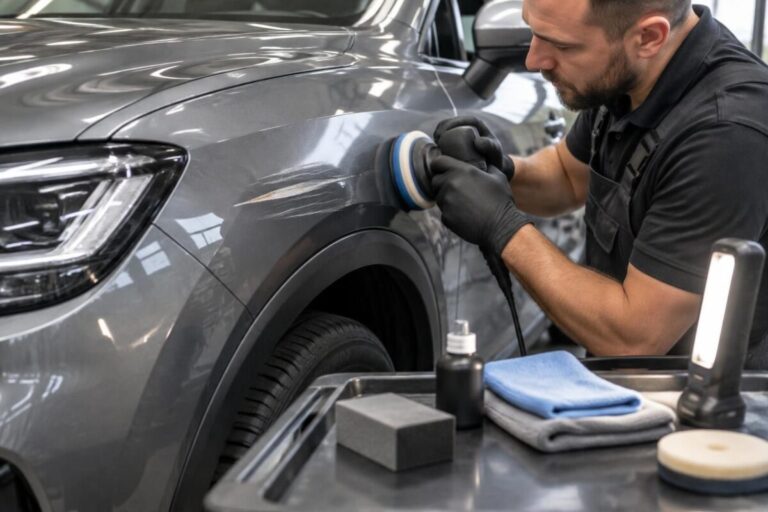
A polishing pad is used to spread polish and correct certain paint defects. A sanding block, on the other hand, holds an abrasive so you can work the surface flat. These automotive bodywork tools don’t replace your hand: they help you work more evenly when the surface or task calls for it.
Pad or hand: which tool should you choose for car bodywork?
Working by hand gives you easy control over pressure and small areas. It’s often the best choice for applying wax, treating a minor defect, or working near an edge without using a machine.
A pad attached to a polisher covers large areas more evenly and takes less effort. A dual-action polisher is generally easier to use than a rotary model, which requires more skill and can heat the paint if you linger in one spot.
| Task | Recommended tool | What to watch out for |
|---|---|---|
| Apply wax or a protective coating | Soft hand applicator | Use a small amount of product. |
| Revive a panel or correct minor defects | Polishing pad and dual-action polisher | Test on an inconspicuous area. |
| Sand a small, flat surface | Sanding block or suitable block | Keep the pressure even. |
| Work on a contour or narrow area | Hand sanding | Protect the edges and work without applying excessive pressure. |
For a small touch-up or waxing, work by hand. If you’re polishing an entire panel, use a suitable pad, ideally with a dual-action polisher.
Abrasive pads and sanding blocks are not for polishing
Automotive sanding is intended to level a surface or prepare it for a repair; polishing is aimed more at improving the appearance of the clear coat. An abrasive pad or sandpaper on a block removes material: it’s not an accessory to use like a polishing pad.
For a bodywork repair, match the abrasive grit to the substrate and the stage of the work. If you’re a beginner, take care around edges and avoid sanding paint if you’re unsure of its thickness or condition. The choice of sanding tools always depends on the area, the material, and the result you want.
Surface preparation: the foundation of a clean bodywork finish
Wash the car, rinse it, then dry it with a clean microfiber cloth. Dirt trapped under a pad can leave new marks instead of improving the paint.
Work in a ventilated area away from direct sunlight. Wear gloves and safety glasses if sanding or the products you’re using could cause dust or residue to fly.
A car owner once tried to correct a light mark on a door by hand, but his applicator was loaded with dust. After cleaning and replacing the pad, the work became much more even. A clean tool protects the result as much as it protects the paint.
Sanding with a pad or by hand: the 3-step process
- Step 1: assess the surface. Clean it and inspect the defect under bright light. If the scratch catches your fingernail clearly or exposes another layer, don’t try to remove it by polishing.
- Step 2: choose your tool and test it. For light polishing, start with a soft pad and a mildly abrasive polish. For localized sanding, use a suitable block and an abrasive appropriate for the substrate, then test on an inconspicuous area.
- Step 3: work gradually. Work in small areas, using overlapping passes and moderate pressure. Wipe away the residue and check the result before continuing.
“The right technique starts with the right diagnosis.” If the paint heats up, the clear coat seems to have been breached, or the result gets worse, stop: professional help can prevent further damage.
Keep your pad effective while you work
A pad clogged with polish or residue won’t work as evenly. Clean it as soon as it gets dirty, and switch pads when moving from an abrasive product to a finishing product.
After polishing, remove the residue with a clean microfiber cloth and apply a suitable protective coating if the paint allows. Gentle washing and clean accessories help preserve the bodywork finish you’ve achieved.
If you see circular marks, uneven gloss, or product splatter, stop the machine and check the pad, the amount of polish, and the cleanliness of the surface. Applying more pressure is generally not the right solution.
Choosing between a pad and working by hand without taking risks
For beginners, working by hand is suitable for modest touch-ups and protective products; a pad is more practical on large surfaces, provided you choose the right pad and keep the machine moving. For a deep defect or fragile paint, ask a bodywork specialist or detailing professional for advice.
Can hand polishing remove a scratch?
It can reduce some superficial marks, but polish won’t necessarily remove a deep scratch. If it catches your fingernail clearly or exposes another layer, have the paint assessed before working on it.
Which pad should I choose to get started?
For light polishing, a soft or medium foam pad is often a safe choice. The right pad also depends on the polish, the machine, and the condition of the paint.
Can you sand directly with a polishing pad?
No. A polishing pad is used with polish; sanding requires a suitable abrasive, generally held by a block or backing designed for the task.
When should I stop working?
Stop if the surface heats up, the clear coat appears damaged, or the defect persists despite a light correction. A deep scratch or fragile paint warrants advice from a professional.
Thanks for reading; best wishes, Patrick