Forgotten maintenance: your first car could trap you
Hello, this is Patrick.
To keep your first car from catching you out, follow its maintenance schedule, check the essentials every month, and ask for a detailed estimate before any major repair.
A car that starts isn’t necessarily a car without risks: a delayed oil change, worn tires, or faulty brakes can quickly turn a small saving into a hefty bill. Car maintenance is easier to manage when you plan for expenses and know what to look out for.
The budget varies depending on the model, age, and mileage. As a guideline, available estimates often put a young driver’s maintenance costs at around €800 to €1,000 per year; this amount can rise if you drive a lot or if several parts are nearing the end of their service life.
Things to do right away
- Write down the mileage and the date of the last oil change in the maintenance log.
- Check the tire pressure when the tires are cold and inspect their wear once a month.
- Test the lights and keep an eye on warning lights, unusual noises, and vibrations.
- Ask for a detailed estimate before a major repair, then compare two garages.
- Set aside money for maintenance: even a small city car may need a new battery or brakes.
To plan your checks, see these tips on maintenance based on mileage and on how to weigh age against mileage. They’ll help you tailor maintenance to your car instead of following a schedule at random.
The pitfalls of neglecting maintenance on your first car
The risk is simple: putting off one task can speed up the wear of another part. Oil that’s too old lubricates the engine less effectively; incorrect tire pressure can cause uneven tire wear. In the end, the expense you avoided at first may not stay avoided.
A full service often costs around €130, but the price depends on the vehicle and the work involved. A roadworthiness test generally costs €80 to €120 every two years; however, it doesn’t replace regular checks or necessary repairs between tests.
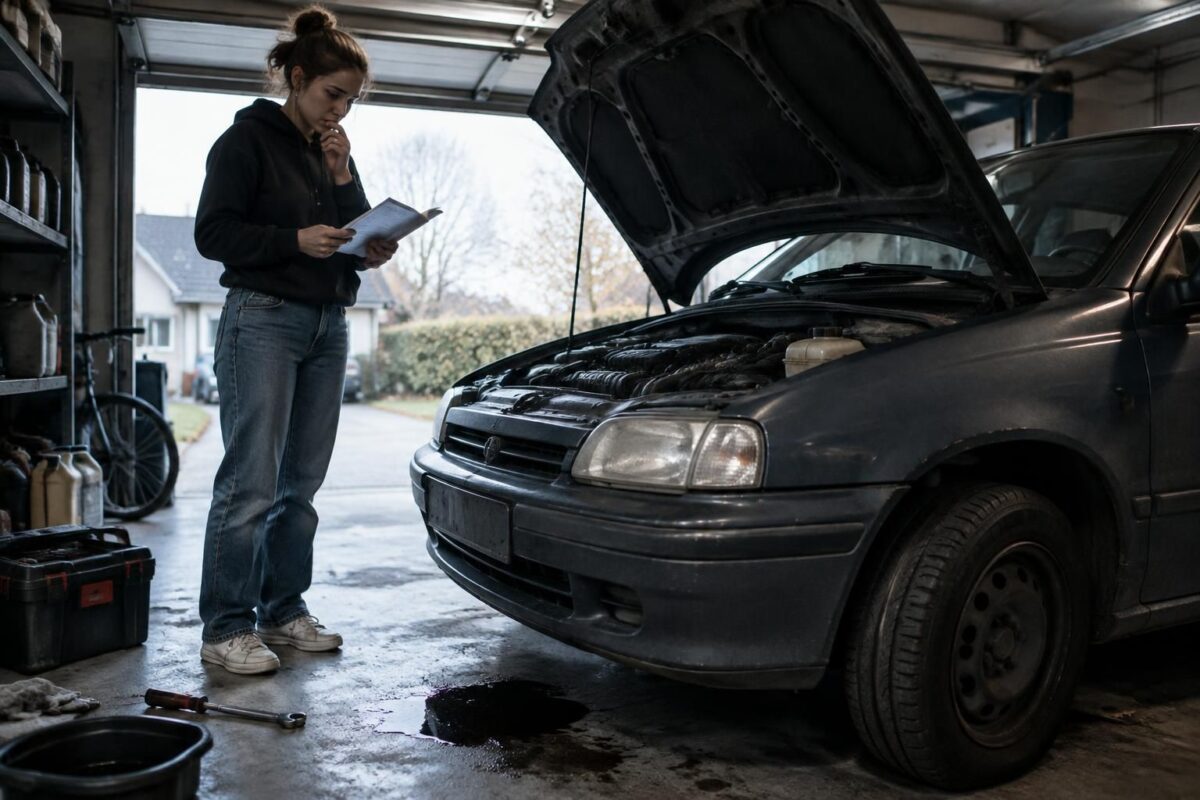
Take Lina, who buys a used car with 150,000 km on the clock. She has no recent proof of an oil change and notices that the clutch slips uphill: having both checked promptly helps her distinguish routine maintenance from a more expensive repair.
Wear-and-tear parts to keep an eye on first
Brake pads can last around 30,000 to 50,000 km, depending on your driving style and the journeys you take. A metallic squeal, an unusually soft pedal, or vibrations when braking warrant a prompt inspection: faulty brakes are not something to take risks with.
A battery often lasts between 4 and 6 years. If starting becomes difficult in cold weather or electrical equipment starts behaving strangely, have the battery tested before it leaves you stranded.
On a car with high mileage, a slipping clutch, difficulty shifting gears, or a burning smell when going uphill all warrant a diagnosis. Replacing it can cost more than €700 including labor, depending on the model and garage: it’s best to get an opinion as soon as symptoms appear.
Also inspect the lights and tires. The legal minimum tread depth is 1.6 mm, but replacing tires at around 3 mm helps preserve grip, especially in the rain; uneven wear can indicate a wheel alignment problem.
Maintenance costs: expenses to plan for
The annual cost depends mainly on the vehicle’s mileage, age, and initial condition. Above 16,000 km per year, usage-related work can significantly increase the bill; the maintenance log and receipts help you see what has already been done.
| Item | Useful guideline | What to do |
|---|---|---|
| Oil and oil filter change | According to the manufacturer’s recommendations | Follow the time or mileage interval, whichever comes first. |
| Brakes | Pads often last around 30,000 to 50,000 km | Have any noise, vibration, or change in pedal feel checked. |
| 12 V battery | Often lasts 4 to 6 years | Ask for a test if the engine turns over more slowly or the dashboard lights flicker. |
| Tires | Legal minimum: 1.6 mm; prudent replacement at around 3 mm | Check the pressure, tread depth, and uneven wear. |
| Roadworthiness test | Generally every two years for a passenger car | Book the test in advance and fix any issues identified. |
These figures are guidelines, not universal intervals. The vehicle’s manual and recommendations for its engine take priority: two models of the same age may have different needs.
Used cars: avoid unpleasant surprises at the garage
An incomplete maintenance log doesn’t prove on its own that a car has been poorly maintained, but it makes its history harder to verify. Ask for any available receipts and have the essential parts checked before a long trip or a major expense.
For some repairs, a part from the circular economy can reduce the bill. In France, professionals must offer, when conditions allow, reused parts for certain categories, such as removable body panels, lights, or certain components; parts directly related to safety, such as braking or steering components, are not covered by this option.
Before accepting a used or refurbished part, check its compatibility, condition, traceability, and the warranty offered. Savings of 50 to 70% may be possible depending on the part number, but they’re never guaranteed: compare the full estimate and the installation terms.
Mistakes that drive up the bill
- Choosing a garage without asking for a breakdown: the estimate should itemize the parts, labor, and work to be done.
- Putting off an oil change without checking the recommendations: saving money by missing a service interval isn’t a good deal if it speeds up engine wear.
- Confusing the roadworthiness test with maintenance: a periodic inspection doesn’t replace checks between tests.
- Ignoring warning signs: diagnosing a noise or vibration early often costs less than dealing with a full-blown mechanical failure.
You can ask to have replaced parts returned to you when possible and appropriate, then keep the estimate and invoice. For a major repair, getting a second opinion can help you avoid approving work in a rush when you don’t understand why it’s needed.
Three steps to get your car maintenance back under control
- Take stock. Note the mileage, gather your receipts, and write down the dates of oil changes, tire replacements, and brake work. If any information is missing, ask the garage to check the priority items.
- Schedule simple checks. Once a month, spend about ten minutes checking the fluid levels, tires, and lights. If a warning light comes on, you spot a leak, or hear a new noise, don’t just reset the alert: find out what’s causing it.
- Compare options before getting repairs. Ask for a clear estimate, check the proposed parts, and compare another professional for expensive work. Keep every receipt with the maintenance log: this makes it easier to track maintenance and helps protect the car’s resale value.
These steps don’t replace a mechanic, but they help you spot problems sooner and make informed decisions. They’re also a useful road safety habit: a well-maintained car and tires in good condition reduce the risk of unpleasant surprises on the road.
Practical questions about maintaining your first car
How much should you budget for maintaining your first car?
The budget depends on the model, mileage, and condition. As a rough estimate, a young driver’s maintenance costs are often around €800 to €1,000 per year, excluding significant fluctuations due to a breakdown or an exceptional repair.
How often should you change the oil?
Follow the manufacturer’s recommendations for your engine. The interval may be based on mileage, time, or both; follow whichever comes first.
Can you fit used parts to your car?
Yes, certain reused parts may be offered for eligible repairs. Check compatibility, traceability, and the warranty, and choose new parts when safety or regulations require it.
Is the roadworthiness test enough to check the condition of your car?
No. It’s a periodic inspection, not a maintenance program. Keep checking fluid levels, tires, lights, and any unusual signs between inspections.
Thanks for reading! If this resonates with you, share your experience in the comments. — Patrick