Motorcycle clicks but won’t start: what to check first
Hi, this is Patrick. If your motorcycle clicks but won’t start, check the battery and its connections first: low voltage or loose terminals are often to blame.
A single sharp click usually means the relay is receiving the command, but the starter isn’t turning. Before replacing a part, distinguish this noise from a series of rapid clicks or complete silence: each symptom points to a different cause.
What to do now
- Check the safety interlocks: raise the side stand, set the kill switch to “run” and try starting in neutral with the clutch pulled in.
- Watch the dashboard: warning lights that dim when you try to start the bike may indicate a discharged battery.
- Inspect the terminals: with the ignition off, check that they’re clean and tight, with no signs of corrosion.
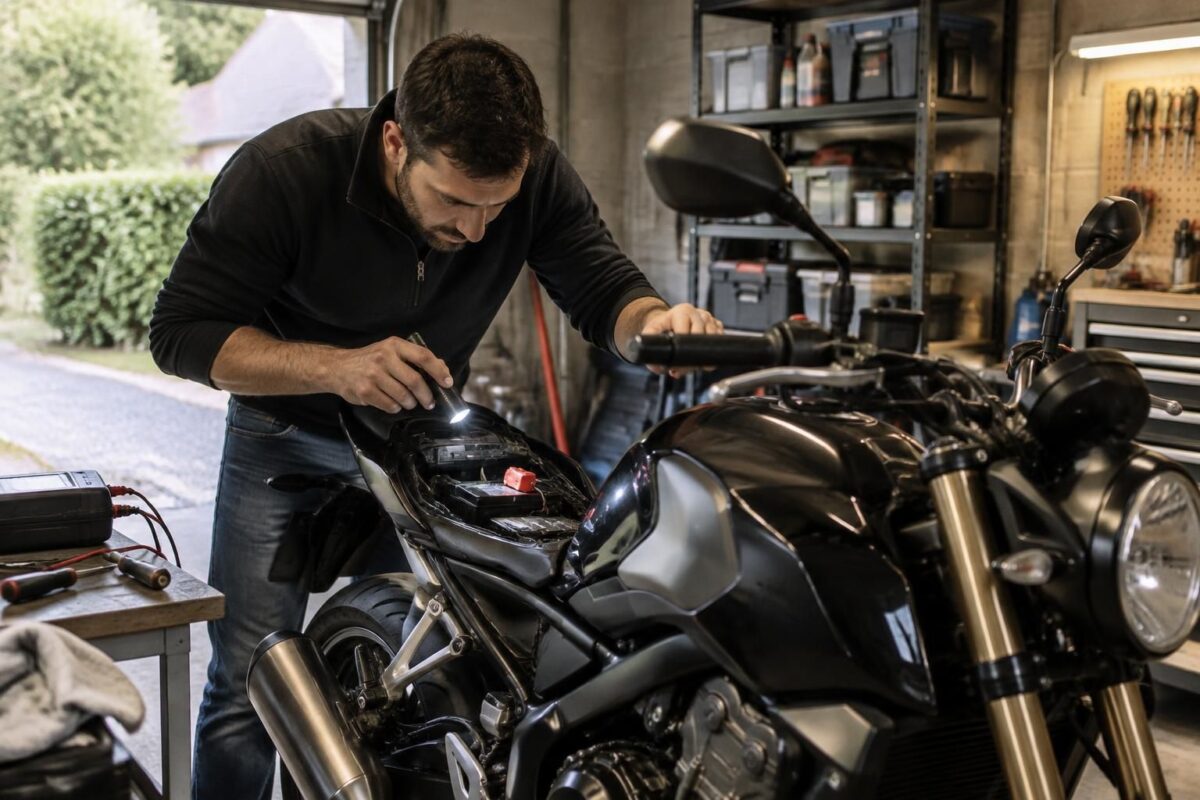
- Measure the voltage with a multimeter set to DC: around 12.6 V with the engine off indicates a charged battery.
- Identify the sound: a single click, rapid clicking and slow cranking don’t all point to exactly the same problem.
For a broader diagnostic approach, also see possible causes of a motorcycle that won’t start and what to check when it powers on but the engine won’t crank.
Motorcycle clicks but won’t start: interpreting the sound
A single sharp click often comes from the relay, also called the solenoid: it tries to send power to the starter, but there may not be enough available current. Repeated clicks more often point to a very weak battery or an electrical connection that isn’t passing enough current.
If the starter turns slowly, the battery is still a prime suspect, even if the dashboard lights look normal. On the other hand, if the engine cranks strongly but won’t start, look instead at the ignition or fuel supply.
| What you notice | First thing to check |
|---|---|
| One click, no cranking | Battery, terminals, ground, relay or solenoid |
| Repeated rapid clicks | Discharged battery or unstable connection |
| Dashboard shuts off | Voltage too low or poor electrical contact |
| No response when pressing the button | Fuse, safety switch or starter control |
Check the battery, terminals and ground
Measure the voltage directly across the battery terminals with the engine off. A reading close to 12.6 to 12.8 V generally indicates a well-charged battery; around 12.0 V or less means it’s heavily discharged. If you can leave the multimeter connected while you try to start the bike, a drop below about 9.5 to 10 V suggests the battery isn’t supplying enough power.
Next, inspect the ground cable, which connects the battery to the frame or engine. A loose or corroded terminal, or a damaged cable, can cause the same symptoms as a battery nearing the end of its life. Don’t bridge the relay’s large terminals with a tool: a short circuit can cause burns or damage the circuit.
Check the relay, fuse and switch
If the battery is charged and the connections are clean, the starter relay becomes a strong possibility. The click may simply confirm that its control is working, not that its contacts are passing current properly. An accurate electrical check depends on the model; if you don’t have the wiring diagram or experience, avoid improvised tests.
Also check the main fuse and safety interlocks: side stand, clutch lever and neutral switch. A faulty switch can prevent the bike from starting or interrupt the starter command, even if the battery is in good condition.
Three-step diagnostic procedure
- Rule out simple interlocks. Put the motorcycle in neutral, raise the side stand, check the kill switch and pull in the clutch lever.
- Test the electrical supply. Measure the voltage, then check the terminals, ground and fuse. If the battery is weak, recharge it with a suitable charger.
- Have the starting circuit checked. If the battery is still in good condition but the clicking continues, have the relay, solenoid and starter tested before replacing any parts.
For example, if the dashboard lights dim when you hear the click, start by recharging and testing the battery. If they stay bright and the connections are secure, have a professional check the relay or starter.
When to take the motorcycle to a mechanic
Stop trying to start it if a fuse keeps blowing, you find a melted cable or the starter makes an unusual grinding noise. A persistent problem despite a charged battery may require an electrical circuit test, or even electronic diagnostics on newer motorcycles.
Also avoid holding the button down for long: repeated attempts can overheat the cables and drain the battery. A methodical check often costs less than replacing parts at random.
Does a single click mean the relay is dead?
Not necessarily. The relay may activate even if the battery is too weak or the terminals and ground are in poor condition. Check the voltage and connections first.
Can a new battery prevent the motorcycle from starting?
Yes. It may not be sufficiently charged, may be connected incorrectly, or there may be a problem with the fuse, switch, relay or starter. Also check the polarity and make sure the terminals are tight.
Can I bump-start the motorcycle?
It depends on the model. This method isn’t suitable for all motorcycles, including some fuel-injected models. Check the manual before trying, and don’t push the motorcycle if you can’t do so safely.
When should I replace the starter relay?
Replace it only after checking the battery, connections, ground and fuse. A circuit test can confirm whether the relay is no longer passing current properly.
Thanks for reading! Feel free to share your observations in the comments. — Patrick